
Stephen Rayment
Founder, CEO & Group Managing Director
Founder, CEO & Group Managing Director
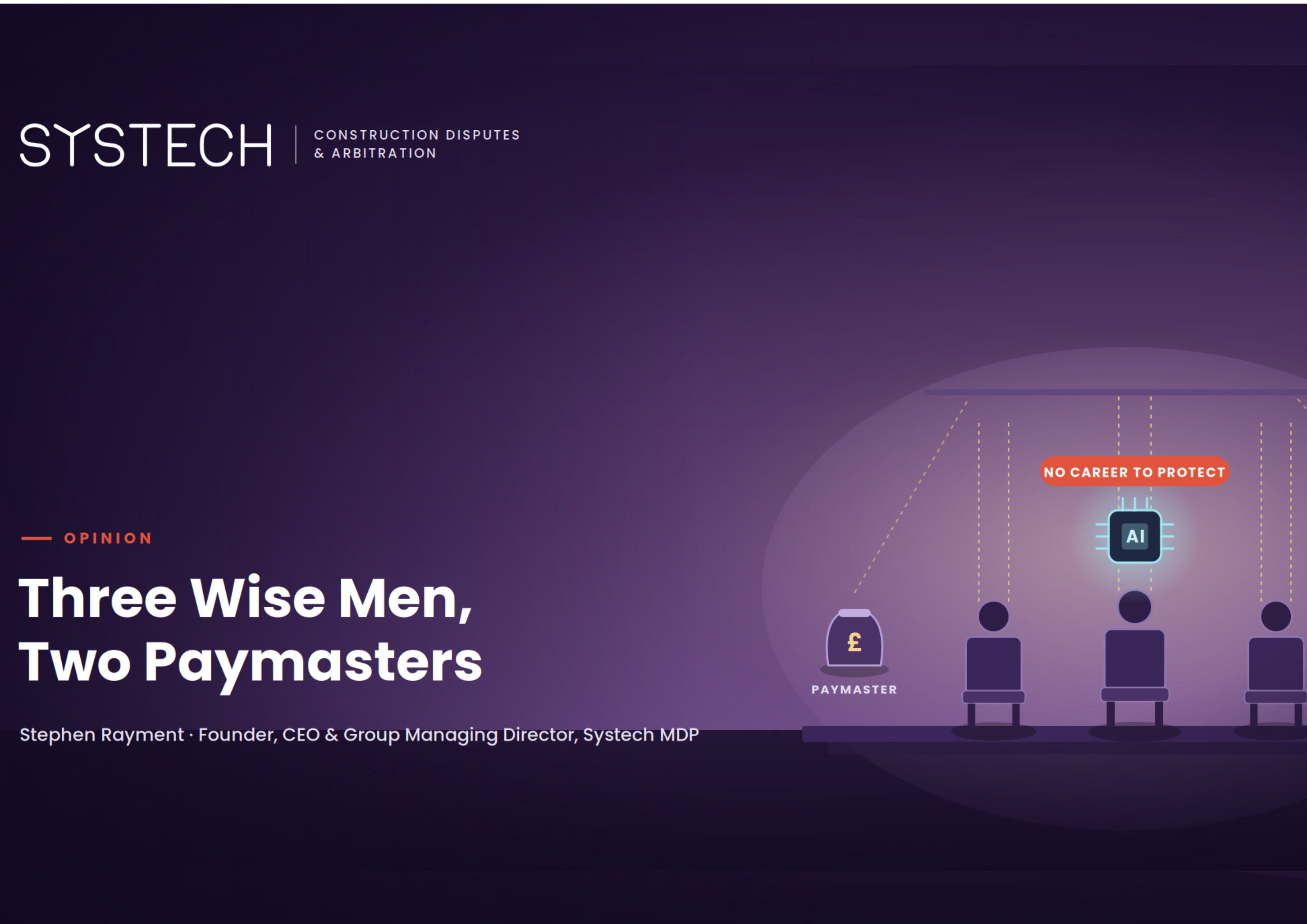
Why arbitral “independence” is the politest fiction in dispute resolution, and why the only incorruptible decision-maker may not be a person at all.
Arbitration sells itself on a single, seductive promise: a neutral, expert tribunal that decides your dispute on its merits, privately and finally. Strip away the marketing and look at how a three-member tribunal is actually built, and a more uncomfortable picture emerges. The structure we treat as the gold standard of commercial justice is, by design, a structure in which not one of the three decision-makers arrives free of obligation to the people paying the bills.
This is not a fringe complaint. In April 2010, in his inaugural lecture as holder of the Michael R. Klein Distinguished Scholar Chair at the University of Miami, Jan Paulsson, about as establishment a figure as international arbitration possesses, called the practice of party-appointed arbitrators “ill-conceived,” an “unprincipled tradition,” and a “moral hazard.” 1 Coming from a man who built a career inside that system, it was the equivalent of a cardinal questioning the doctrine. Fifteen years later the practice is entirely undisturbed. That tells you less about the strength of the rebuttals than about the comfort of the status quo.
Start with the two so-called party-appointed arbitrators. The polite theory is that each party simply contributes expertise and confidence to the panel. The honest theory is the one every litigator operates on in private: you appoint the arbitrator you believe will be receptive to your case. Nobody briefs counsel to find a genuinely neutral mind; they instruct counsel to find someone whose published views, prior awards, and known temperament point in the right direction.
If that sounds cynical, consider the evidence the critics lean on. Paulsson and others pointed to studies of dissenting opinions suggesting that, overwhelmingly, the dissent in a split award comes from the arbitrator nominated by the losing party. The most-quoted figure is around 95 per cent; 2 honest critics of the methodology put it lower, perhaps 80 to 85 per cent. 3 Pick whichever number you find credible; both describe the same phenomenon.
The party-appointed arbitrator who breaks ranks does so, almost without exception, in the direction of the party who chose him. We can call that coincidence, or we can call it what it looks like: systematic alignment between appointment and outcome. The defenders’ answer is that this is harmless because it cancels out: one leaner on each wing, balanced by a neutral chair. Which brings us to the real problem.
In the standard model, the chair is not chosen by a neutral institution. The chair is chosen by the two party-appointed arbitrators, who are, in turn, the creatures of the instructing solicitors on each side. The chairman who emerges is, almost invariably, someone known to both camps. That familiarity is sold as a virtue: a safe pair of hands, someone everyone trusts. It is worth asking why everyone trusts him.
Arbitrators are not salaried judges. They are sole traders whose next instruction depends on remaining acceptable to the small, repeat-playing group of solicitors and counsel who put names forward. The pool of construction and commercial arbitrators who chair serious references is not large, and neither is the pool of firms that feed them work. The chair sitting today knows perfectly well that both sets of instructing solicitors in front of him are potential sources of his income next year and the year after. He is, in the most literal sense, auditioning for both sides at once. This is not a hypothetical. Experienced practitioners have long noted that where a clause leaves the chair to be chosen by the parties or their two appointees, the parties work hard to avoid the fallback of letting an institution appoint; they would much rather keep the choice within the circle. David A. R. Williams KC made exactly this observation to construction lawyers over a decade ago. 4 The preference is revealing. A truly neutral appointment is the one option the system instinctively routes around.
Put the incentives together and the conclusion writes itself. You have two decision-makers structurally inclined toward the party that appointed them, and a third whose commercial survival depends on alienating neither side’s solicitors. That is not a recipe for a decision on the merits. It is a recipe for a decision that keeps everyone in the room employable.
Here is the quiet consequence. A chair who must not fall out with either instructing team has every reason to avoid the clean, decisive, one-sided award, the kind that delights one firm and humiliates the other. The path of least professional risk is the split: give each side something to take back to the client, and you offend no one whose goodwill you depend on.
Construction arbitration offers the textbook mechanism, and it is one most practitioners will recognise instantly. Consider the tribunal that grants the contractor a generous extension of time, vindication, a defence against liquidated damages, a headline win, but then declines to award the loss and expense or the costs that ought, on the merits, to follow from it. The contractor walks away with the clock reset; the employer walks away having kept the chequebook shut. Two partial victories, two satisfied sets of solicitors, and an award that looks balanced precisely because it refused to commit.
Decided strictly on the merits, time and money usually travel together: if the delay was the employer’s responsibility, the contractor is generally entitled both to the time and to the cost of standing around during it. Severing the two, handing over the time while withholding the money, is rarely a finding the evidence compels. It is far more often a finding the politics of the room compels. “Time without costs” can be sound on the facts. It can also be the most elegant way ever devised to split the baby while calling it justice.
In fairness, the system’s defenders are neither naïve nor few, and the argument is genuinely contested rather than settled. Charles Brower and others insist the system is self-policing: conflict-disclosure rules, challenge procedures, and the reputational cost of being seen as a party’s hired gun keep arbitrators honest. 5William W. Park argues that party input into selection is a long-standing feature that actually strengthens confidence in the outcome, since a party that helped build the tribunal is far less likely to resist its award, which is no small thing in a system built on voluntary compliance. 6 Giorgio Sacerdoti and Alexis Mourre make versions of the same point; 7 Michael Schneider memorably dismissed the whole panic as a kind of “vicarious hypochondria.” 8 And there is a market answer that is hard to wave away: the LCIA appoints every arbitrator through its Court by default, yet parties routinely opt out of that neutrality to nominate their own. 9 Even Paulsson conceded the practice is genuinely popular. 10 If unilateral appointment were really experienced as a fraud on the process, why do sophisticated, well-advised parties keep insisting on it?
These are real arguments. But notice what they mostly defend. They defend legitimacy in the eyes of the parties: the feeling of having had a say, the willingness to accept the result. That is a defence of arbitration as a satisfaction-management exercise. It is not, on its own, a defence of arbitration as a truth-finding one. “The parties feel better about an award they helped engineer” and “the award is correct” are different claims, and the structure rewards the first far more reliably than the second.
If we took the problem seriously rather than ritually noting and ignoring it, the fixes are not mysterious. Make neutral or institutional appointment of the entire tribunal the default, reserving unilateral appointment for parties who expressly bargain for it with eyes open. Use screened or “blind” selection so an arbitrator does not always know which side put his name forward. Demand fully reasoned awards on every head of claim, because a tribunal forced to justify granting time while refusing costs will find the compromise far harder to disguise. And hold the line on costs following the event, so that splitting the result carries a visible price rather than passing as Solomonic wisdom.
None of this will happen quickly, because the people best placed to reform the system are the people the current system has made comfortable. That is the real moral hazard: not merely that arbitrators may lean toward those who feed them, but that an entire profession has a quiet collective interest in never asking too loudly whether they do.
But notice what every reform above has in common. Neutral appointment, blind selection, reasoned awards, costs discipline: each is an attempt to manage a human being’s incentives. None of them removes the incentive itself, because you cannot engineer away an arbitrator’s interest in his own next instruction. As long as the decision-maker has a career, a chambers, a circle of repeat clients and an invoice to send, capture is not eliminated; it is merely policed. And policing, as we have seen, is exactly what the profession is quietly disinclined to do.
So let us follow the logic to its uncomfortable conclusion. The only decision-maker incapable of leaning toward the party who chose it, of flattering the solicitors it depends on, or of splitting the difference to stay employable, is one that has no career to protect at all. It cannot be re- appointed, taken to dinner, or quietly dropped from a firm’s preferred list. It has no golf-club acquaintance across the table and no instinct to keep both paymasters content. An artificial intelligence, properly built and properly constrained, is the first candidate for the front of the room with nothing to gain from the outcome and no one to please.
The case is not science fiction, and it is not mine alone. Scholars examining arbitrator selection have argued that taking the human out of the decision could eliminate the very pathologies this article describes: the incentive to render compromise awards, and the use of dissents to signal loyalty to whoever might appoint you next. 11 Strip away the self-interest and the biases that come bundled with being a person for hire, and what remains is something closer to the thing arbitration always claimed to be: a decision on the merits, reached the same way every time, indifferent to who is paying.
In construction, the argument is stronger still. The merits of a serious delay-and-quantum dispute live in thousands of pages, programmes, progress records, site diaries, correspondence, payment applications, that no human tribunal reads in full and every human tribunal skims. A machine does not skim. For the first time we could have a decision-maker that has actually read everything, applied the contract consistently across every claim, and granted or refused an extension of time and the loss and expense that the evidence does or does not support, without one eye on the room. The objection writes itself, and it is a fair one. An AI is only as neutral as the data it learns from and the people who build it; capture does not vanish, it migrates, from the arbitrator to the coder, the vendor, or the party with the deeper dataset. A black-box award that no one can interrogate may be worse than a compromised one you can at least challenge. Enforcement regimes and centuries of due-process thinking assume a tribunal that can hear you, give reasons, and be held to account. 12 Whom do you cross-examine when the tribunal is a model?
All true. But here is the provocation: every one of those objections applies to human arbitrators too, only less visibly. Human bias is simply training data we are not allowed to audit. The arbitrator’s leanings, formed over a career of who instructed him and who bought him lunch, are a black box we have agreed not to open out of professional courtesy. A model, by contrast, can in principle be tested across thousands of past awards, its tilt measured, its reasoning demanded, its consistency proven or disproven. We can open the machine. We can never open the man.
The machine does not need to be perfect to win this argument. It needs only to be less capturable than three sole traders auditioning for both sides at once. That is a remarkably low bar, and the fact that it is low is the whole indictment. We should at least stop pretending. The three figures at the front of the room are able, often distinguished, and usually well-intentioned. But independence is a structural property, not a personal virtue, and a structure that ties every decision-maker’s interests to the parties’ lawyers does not produce it. It produces something that looks like independence, and, in this business, looking the part has always been enough. The day we are willing to put the merits before the machine may be the day we finally stop confusing the two.
Notes
1. Jan Paulsson, ‘Moral Hazard in International Dispute Resolution’, inaugural lecture as holder of the Michael R. Klein Distinguished Scholar Chair, University of Miami School of Law (29 April 2010), published as (2010) 25 ICSID Review 339. The characterisations ‘ill-conceived’, ‘unprincipled tradition’ and ‘moral hazard’ appear in that lecture.
2. The much-cited figure derives from Alan Redfern, ‘Dissenting Opinions in International Commercial Arbitration: The Good, the Bad and the Ugly’ (the 2003 Freshfields Arbitration Lecture), (2004) 20(3) Arbitration International, and was deployed by Paulsson; see also Albert Jan van den Berg, ‘Dissenting Opinions by Party-Appointed Arbitrators in Investment Arbitration’ in M. Arsanjani and others (eds), Looking to the Future: Essays on International Law in Honor of W. Michael Reisman (Brill 2011).
3. For a lower estimate and a critique of the single-statistic methodology, see e.g. Anthony Daimsis, ‘Mutual v Unilateral: The Future of Appointing Arbitrators’, The Lawyers Weekly (16 September 2011); and the survey of the debate in Catherine A. Rogers, ‘Reconceptualizing the Party-Appointed Arbitrator’ (faculty scholarship, Penn State Law / Queen Mary, University of London).
4. David A. R. Williams KC (then QC), Address to the Society of Construction Lawyers (DIFC Courts, 20 March 2011), observing that where a dispute-resolution clause calls for the parties or the two party-appointed arbitrators to appoint the chair, it is commonly observed that they try hard to avoid the default mechanism of an institutional appointment.
5. Charles N. Brower and Charles B. Rosenberg, ‘The Death of the Two-Headed Nightingale: Why the Paulsson–van den Berg Presumption that Party-Appointed Arbitrators are Untrustworthy is Wrongheaded’ (2013) 29 Arbitration International 7, arguing that internal controls prevent any impermissible quid pro quo.
6. William W. Park, ‘Arbitrator Integrity: The Transient and the Permanent’ (2009) 46 San Diego Law Review 629, 644.
7. Giorgio Sacerdoti, ‘Is the Party-Appointed Arbitrator a “Pernicious Institution”? A Reply to Professor Hans Smit’ (Columbia FDI Perspectives No 35, 15 April 2011); Alexis Mourre, ‘Are Unilateral Appointments Defensible? On Jan Paulsson’s Moral Hazard in International Arbitration’ (Kluwer Arbitration Blog, 5 October 2010).
8. Michael E. Schneider, ‘President’s Message: Forbidding Unilateral Appointments of Arbitrators, a Case of Vicarious Hypochondria?’ (2011) 29(2) ASA Bulletin 273.
9. Under the LCIA Rules the LCIA Court selects the members of the tribunal; in practice parties frequently depart from that default. Of 469 appointments in 2016, only 197 (about 39 per cent) were selected by the LCIA Court, the remainder being chosen by the parties or the co-arbitrators: LCIA, Facts and Figures 2016.
10. Jan Paulsson, ‘Are Unilateral Appointments Defensible?’ (Kluwer Arbitration Blog, 2 April 2009); and, refining his position, ‘Must We Live with Unilaterals?’ (2013) 1(1) ABA Section of International Law, and The Idea of Arbitration (OUP 2013) 276–277, where neutral appointment is proposed only as a default rule.
11. Mel Andrew Schwing, ‘Don’t Rage Against the Machine: Why AI May Be the Cure for the “Moral Hazard” of Party Appointments’ (2020) 36(4) Arbitration International 491.
12. Convention on the Recognition and Enforcement of Foreign Arbitral Awards (New York, 10 June 1958), art V: enforcement of an award may be refused where a party was unable to present its case or the tribunal was not constituted in accordance with the parties’ agreement. On whether AI-rendered awards can be reconciled with such frameworks, see Michael J. Broyde and Yiyang Mei, ‘Don’t Kill the Baby! The Case for AI in Arbitration’ (2024) 21(1) NYU Journal of Law & Business. Editor’s note on sources: the notes above are accurate and citable. Two caveats before publication. First, the ‘95 per cent’ dissent statistic rests on a small evidential base and its methodology is contested; the text hedges it, and the lower 80 to 85 per cent estimate is given alongside. Second, the ‘time without costs’ construction example and the AI-tribunal proposal
This article was originally published in the November 2019 edition of Construction law International; Grimes, MA (2019) 14(2) CLInt, 7-9, and is kindly reproduced...
![The price of a definition – Network Rail Infrastructure Ltd v ABC Electrification Ltd [2019] EWHC 1769 (TCC)](https://systech.euwest01.umbraco.io/media/3ivb3ztk/price-of-a-def-4021.jpg)
Imagine millions of pounds relying on an interpretation of a single word. A single word to determine the meaning of a contract’s clauses and the placement of liab...

The construction industry is credit-heavy and complex, a very dangerous combination that often leads to contractors not getting paid on time and/or not receiving ...